
More than a Symbol of Love
The Enduring Story of Roses
Roses hold a rich history of symbolism, mainly as the true epitome of love, but often associated with other virtues, such as beauty, purity, and innocence - and they have carried these meanings for centuries. If something perseveres in the collective consciousness over such an extended period of time, it’s because there isn’t just one reason behind it, but a network of interconnected traces that weave through time and different cultural frameworks - from mythology, art, and literature to societal customs - simultaneously reinforced and reimagined throughout.
In this article, we want to dive deeper into the story behind our stem of the season: from origins, cultivation, and modern varieties to tracing their symbolic attachments through history, myths, and meanings.

From Ancient Origins to Modern Varieties
It’s quick to say the rose is a timeless symbol which holds enduring meaning, but it is easy to underestimate how long the rose truly has been around. According to the Smithsonian Gardens, “[f]ossil evidence found in Colorado in the U.S. suggests that plants in the rose family have existed for at least 35 million years.”
To this day, roses exist in the wild and in gardens across the globe. The oldest living rose grows along the walls of Hildesheim Cathedral in Germany and is recorded to be over 700 years old. While there is an abundance of modern varieties, botanists often group roses into three classes to trace their history as plants: Species, Old Garden Roses, and Modern Garden Roses.
The three categories of roses
The wild roses that have been around since the time the fossils date back to, are referred to as “Species Roses” and were able to survive and endure in their specific environments for all those centuries through evolution and adaptation. For centuries, however, humans have had a hand in efforts to cultivate roses for variation in colour, form, as well as bloom time and frequency. All roses that were bred as part of these efforts before 1867, are referred to as “Old Garden Roses,” while those after that fateful year are classed as “Modern Garden Roses.”
Now what precisely happened in that year to mark the distinction? A French nurseryman named Jean-Baptiste Andre Guillot created what is considered to be the first hybrid tea rose - fittingly named ‘La France,’ which led to the rather arbitrary but historically significant division between Old and Modern Garden Roses.
Meet some of our roses
To no one’s surprise, we’re also highlighting roses in our arrangements this season - and we’ve got some stunning modern varieties for you to enjoy in your home. Get to know them a little here before they land on your doorstep.

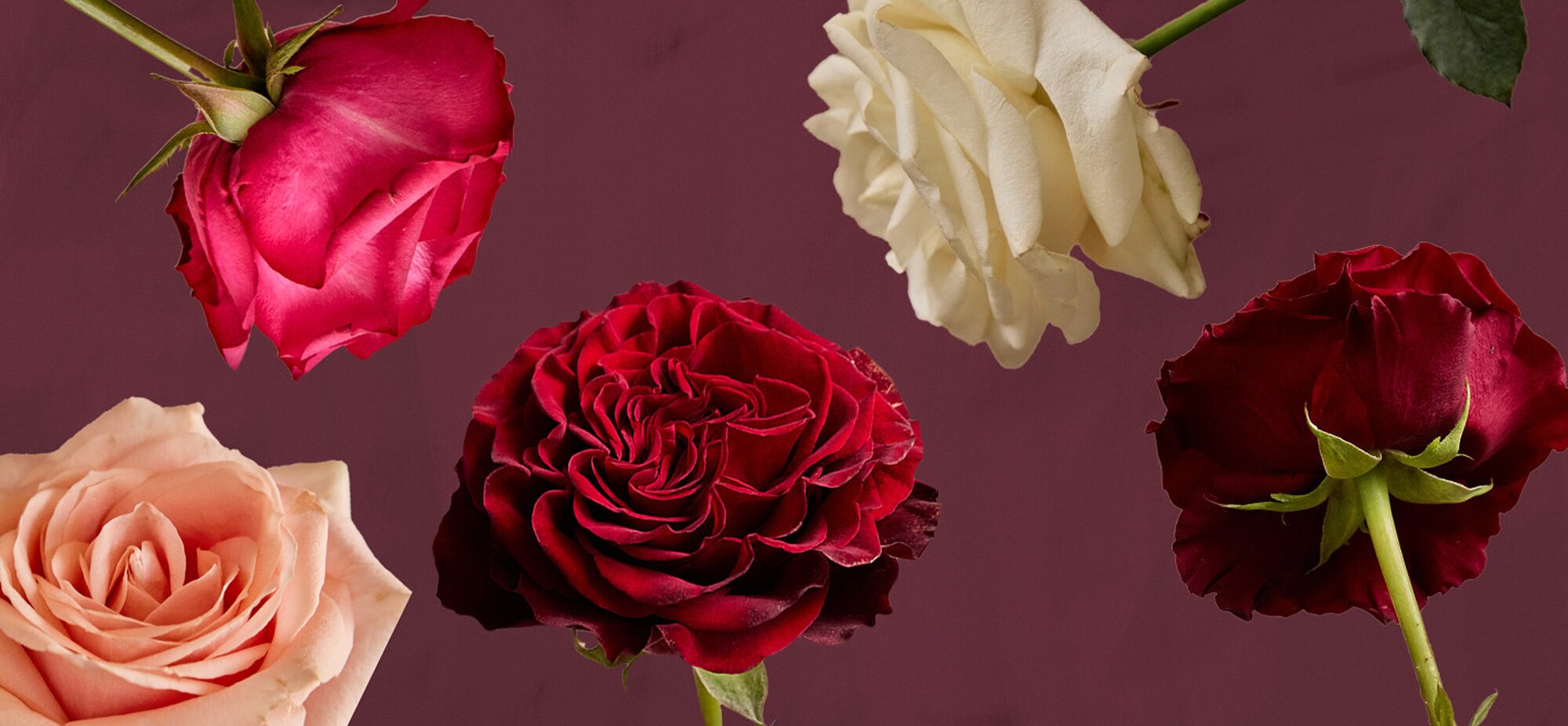
A Hybrid Tea rose variety (kudos to Jean-Baptiste), the Freedom Red rose is known for its large, solitary blooms in a ravishing, saturated red hue. It has an excellent vase life and thrives even in direct sunlight without losing any of its colour and splendour. You can find them in our New Romantics arrangement.

With its rich raspberry-pink shade and subtly veined outer petals that unfold beautifully, the Lola rose adds a playful pop of colour to any arrangement. The blooms feature large, dense petals which hold their beauty for an impressive amount of time in your vase. You can spot both the Freedom and Lola roses in our vibrant New Romantics bunch.

Another highly-prized Hybrid Tea rose variety, Pearl Avalanche roses unfold in the most marvellous hues - an iridescent, pearly shade that gently flows into hints of salmon, peach, and green, creating a dazzling champagne gradient. You can spot them in our Sun-washed Parchment arrangement.

A slight variation to the above, Sweet Avalanche roses feature large blooms with a high petal-count. Their colour is deeper in the centre, then softens towards the petals into delicate, blush-pink hues with a hint of shimmering green. They can be found in our Cascading Chimes bunch.

The real showstopper this season, the Heart Rose features large, billowing petals that unfurl in velvet textures and deep crimson and burgundy hues from a heart-shaped centre. You can find it stealing everyone’s hearts in our special arrangement featuring exclusively Heart rose stems.
Now, we’re tempted to say it’s the true symbol of love and passion, but let’s have a look at the rich history of where that symbolism comes from before making a snappy statement like that.
Rose Symbolism:A brief and highly selective history
The Greeks & the Romans: Mythological Origins
When we think back to the origins of symbolism, it’s no wonder we always look back towards an ancient world of myths, dotted with goddesses, gods, and tales of heroic deeds. Classical Antiquity was the time that roses came to be associated with Greek deities such as Aphrodite, Eros, and Dionysus and their Roman counterparts, each of whom is identified with beauty, love, passion, and desire in varying facets.
The link between roses and Aphrodite is the most retold and hence most prominent in the cultural consciousness. In the Iliad, Aphrodite uses rose oil to protect Hector’s body. In another piece of lore, the red rose was created when Aphrodite was wounded by the thorns of a rose bush as she rushed to the aid of her lover, Adonis - her tears of grief and immortal blood staining the roses forever red in a symbolic representation of eternal, passionate love.
Aside from their mythological roots, roses were also heavily involved in daily life at the time with wreaths being worn for banquets and ceremonies. Additionally, roses were used for cooking and their oil for cosmetic products of the time.
Did you know?
Interestingly, roses weren't always necessarily gendered as female - as the link between Aphrodite and her incredible beauty may lead to suggest. In fact, roses were strongly associated with male heroism and were "awarded to men for great acts and virtues [...] and it was men who wore perfume made from roses.” writes Amy de la Haye in Ravishing, a piece which explores the legacy of roses in art and fashion.
The Middle Ages: Roses become religious
The adaptation of rose symbolism in Christian mythology, especially during the Middle Ages, is to some extent a similar story of the much older pagan myths around Aphrodite and other deities. Once again, the colour red was associated with blood, this time with that of Christ and furthermore that of the martyrs. White, in turn, came to be a symbol for the immaculate conception, and, by extension, chastity and purity. It is said that before the Fall, the roses in the Garden of Eden were thornless and only through the original sin did thorns appear. The Virgin Mary is thus often referred to as a “rose without thorns,” pure and without sin.
The Wars of the Roses: Emergence of England’s national flower
Between 1475 and 1487, roses were at war in England during a conflict between rival houses of the royal Plantagenet family. In essence a struggle of dynastic succession, both the House of York (sporting a white rose as their emblem) and the House of Lancaster (a red rose on their banners) felt they had the superior claim to the throne.
A series of battles, complex alliances, as well as intrigue, lies, and betrayals, which have captivated students of history for years, unfolded until Richard III was killed during the Battle of Bosworth Field in 1485 and Henry VII of the House Tudor ascended the throne.
In a clever play, Henry VII literally married the red and white roses of the quarreling parties by taking Elizabeth of York as his wife, thereby uniting the houses and creating the Tudor Rose: five white petals in the centre for York surrounded by five red petals for Lancaster. To this day, the Tudor Rose represents the national flower of England.
Still-Life Symbolism: Renaissance and the Dutch Golden Age
While the rose has always retained its emphasis on beauty and love, we have already seen that on the flipside of those sentiments, grief and loss come into play. Throughout the Renaissance and culminating in the Dutch Golden Age, political conflict and unrest triggered fears and anxieties among the public. Artists of the time relied heavily on symbolism to create still-life paintings ripe with hidden meaning, with roses frequently featured in them.
Often paired with skulls, books, musical instruments, and clocks to represent the vanity of worldly possessions, roses became symbolic of the key juxtaposition between life and mortality: the blooming rose signifying youthful beauty, passion, and love; the wilting rose as a powerful reminder of the inevitable passage of time and the fleeting nature of that beauty and life.
French Rococo: Roses become fashion
It was during the Rococo era that roses earned the spot as a fashion statement in the French court, with rose embellishments shimmering on the opulent gowns of the trendsetting ladies at the palace. Roses also featured frequently as the backdrop of Marie Antoinette’s pastoral portraiture, which has been interpreted as a link to the symbolism of the rose in Christian iconography, showcasing her purity and Christian virtues.
The Victorians: And their secret flower language
Flower symbolism in general had its heyday in the Victorian Era, when a whole language was created to communicate through flowers - Floriography. To bypass the strict and stuffy societal etiquette of the time, people used flowers as a way to convey hidden meanings, attributing different sentiments to everything from the types and colours of flowers to the way a ribbon is tied or with which hand a bunch is handed over.
That’s where an avalanche of faceted meanings swept over roses, with examples including:
Burgundy Rose – Unconscious beauty
Orange Rose – Fascination
Pale peach Rose – Modesty
Pink Rose – Grace
Purple Rose – Enchantment
Yellow Rose – Infidelity
Red Rose – Love
Unravelling and Challenging our View of Roses: Modernism, Surrealism, and all the other 20th century -isms
Movements in art shifted in the 20th century, with modernism and its accompanying -isms moving away from the use of symbolism towards abstraction as a new means of communicating meaning, or even towards a total negation of any meaning.
A good example to pick out for our discussion of roses is surrealist painter Georgia O’Keeffe, whose work features enlarged and abstracted roses that force viewers to engage with perspective, detailing, and evocations - both reinforcing and challenging the meanings these flowers have accrued over the years.
An Afterword on Meaning
Let’s end with a quote from the post-modern period. Umberto Eco ends his acclaimed novel The Name of the Rose with the following sentence:
“Stat rosa pristina nomine, nomina nuda tenemus.”
Makes sense, right?
Well, the line has been interpreted in various editions, but it is most commonly translated as: “The rose of old remains only in its name; we possess naked names.” In the post-script, Eco claims to have chosen the title because the rose “is a symbolic figure so rich in meanings that by now it hardly has any meaning left.”
Now, while that sounds rather bleak at first, what it really shows us is how resolutely the rose has persevered throughout time and history - leaving its mark on art, literature, and cultural customs - and that, if you look at it this way, it is so much more than just a symbol of love.
So really, isn’t it beautiful that in our never-ending search for meaning, a flower can pass the test of time and retain in its symbolic significance all the nuances that shaped it?

Posted on 16th January 2026