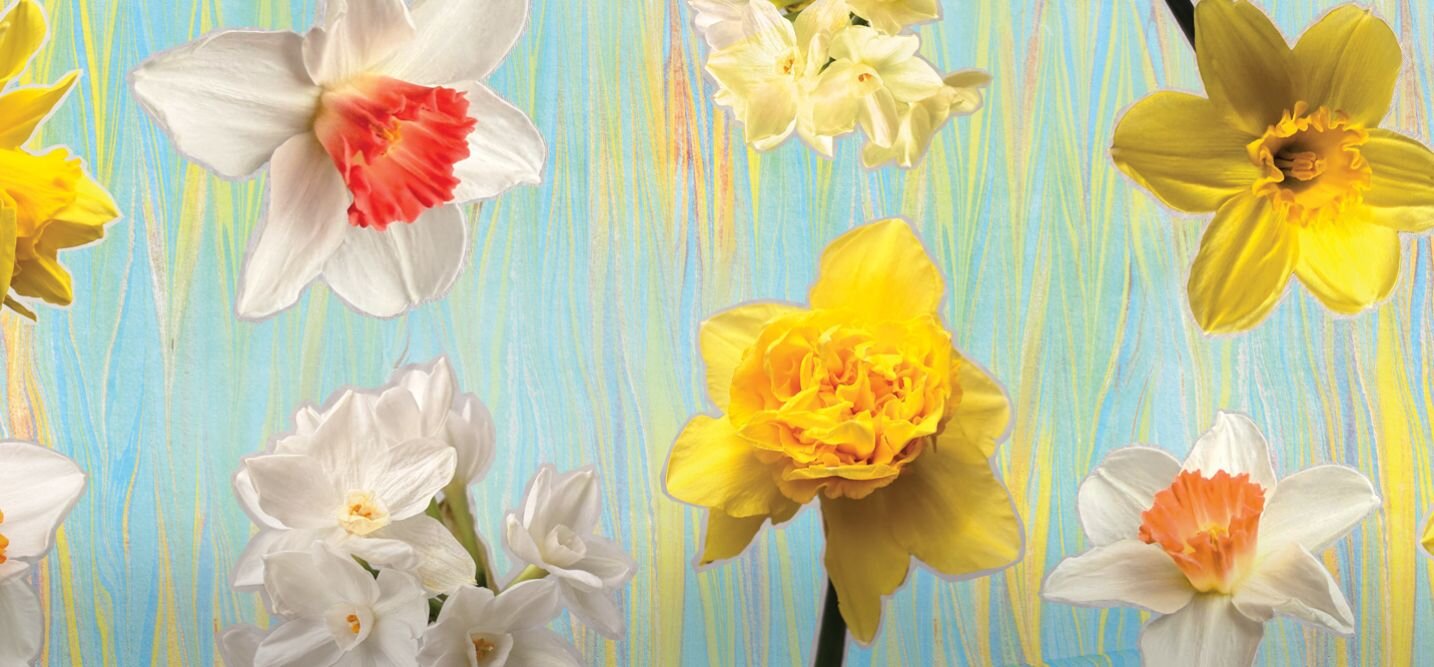

The Humble Daffodil
Despite its bright, canary yellow colour, the humble daffodil can often be overlooked. Through no fault of its own, it flowers so commonly in the UK that our senses may have been made somewhat immune against its beauty. But we’re here to make you fall back in love and fully appreciate these glorious flowers.
The pops of yellow springing up around us simply can’t help but cheer us up, even on a grey commute or a mundane walk to the shop. That’s the quiet power of the daffodil - not just its dopamine-inducing colour, but the fact that it signals better times. Punctually for spring, it’s an early bearer of warmth and sunshine.
The pops of yellow springing up around us simply can’t help but cheer us up, even on a grey commute or a mundane walk to the shop. That’s the quiet power of the daffodil - not just its dopamine-inducing colour, but the fact that it signals better times. Punctually for spring, it’s an early bearer of warmth and sunshine.

Narcissus: origin story
Quite the opposite to the idea of the “humble daffodil,” its botanical name derives from the story of an arrogant youth, namely the Greek myth of Narcissus. It tells the tale of a young man on the search for beauty and perfection, who rejected all those infatuated with him and eventually fell in love with his own reflection. So captivated by his mirror image on the pond’s water surface and unable to attain the object of his desire, he wasted away by the water. When he died, daffodils sprang up in his place.

Daffodil VarietiesWhen you think of daffodils, the first thing you picture is probably the bright yellow trumpet that you spot anywhere from forest trails and roadsides to grandma’s front garden. But there are actually loads of different and striking types - while there are 36 distinct species of daffodils, there are over 26,000 cultivated varieties in total, according to the Royal Botanic Gardens at Kew.

In our daffodil arrangements this season, we’ve handpicked a range of daffodils to give you full and lively bunches, overflowing with blooms. In both Daffodil Delight (50 stems) and Daffodil Dazzle (120 stems), you can expect a colourful pick’n’mix of exclusively British varieties from this selection:

Why do we see daffodils everywhere?As mentioned before, here in the UK, you can see daffodils flowering everywhere - not just in people’s gardens, but along roads, in parks, and sometimes in the most random, unexpected places. So you may wonder - where do they all come from?
A quick daffodil history
Daffodils are thought to have been introduced by the Romans, who most likely brought them over from the Iberian peninsula. They were known to plant daffodils to honour the memory of a loved one or a comrade who’s fallen in battle.
Up until the 19th century, daffodils were mainly wild species or natural hybrids, which have slowly spread in numbers. Only when plant cultivators began to select and breed different flowers for aesthetic purposes and qualities in the 1800s, did the modern daffodil emerge.
While it was often overlooked as a mere wild flower, it became a more prized horticultural specimen thanks to breeding, cultivation, and new hybrid varieties. This also coincided with the rise of industrialisation, especially railway systems, and commercialisation, which meant that flowers could be grown in Cornwall, for instance, and transported to be sold in London.
Up until the 19th century, daffodils were mainly wild species or natural hybrids, which have slowly spread in numbers. Only when plant cultivators began to select and breed different flowers for aesthetic purposes and qualities in the 1800s, did the modern daffodil emerge.
While it was often overlooked as a mere wild flower, it became a more prized horticultural specimen thanks to breeding, cultivation, and new hybrid varieties. This also coincided with the rise of industrialisation, especially railway systems, and commercialisation, which meant that flowers could be grown in Cornwall, for instance, and transported to be sold in London.

Daffodils everywhere!
Nowadays, daffodils are both - prized flowers to brighten up your garden or your home, or cheerful clusters of random roadside blooms. But why do they thrive so well here? First of all, daffodils are extremely hardy and perennial, they can grow well in rough soil or wild meadows, and they’re well adjusted to the damp UK climate. In addition, daffodils spread from bulb easily when left undisturbed - in fact, bulbs have been known to survive in the ground for over a century, while producing flowers consistently for decades. As a bonus, pests like rabbits or deers are not interested in the flowers either.Daffodil Symbolism
For obvious reasons, daffodils are seen as heralds of spring and thereby carry symbolic meaning charged with hope, renewal, and growth. Its bright yellow colour also conveys cheerfulness and joy, while gifting a daffodil can convey deep respect and admiration. Apart from its link to vanity via the Greek myth of Narcissus, the daffodil retains very positive symbolism.
Romantic poetsAt the height of its craze, the Romantic poets became so infatuated with daffodils that it cropped up in art and poetry. Think of Wordsworth’s “I wandered lonely as a cloud,” for instance:
“I wandered lonely as a cloud
That floats on high o'er vales and hills,
When all at once I saw a crowd,
A host, of golden daffodils;
Beside the lake, beneath the trees,
Fluttering and dancing in the breeze.
[...]
For oft, when on my couch I lie
In vacant or in pensive mood,
They flash upon that inward eye
Which is the bliss of solitude;
And then my heart with pleasure fills,
And dances with the daffodils.” The Welsh national flower The daffodil, specifically the Tenby daffodil, is also the Welsh national flower, albeit quite a recent choice. Previously the leek had been the emblem of Wales, but since the daffodil gained popularity during the 19th century, shared a similar Welsh name with “leek,” and was a much more pleasant-smelling alternative for St. David’s Day celebrations, the shift was officially solidified in the 20th century.
“I wandered lonely as a cloud
That floats on high o'er vales and hills,
When all at once I saw a crowd,
A host, of golden daffodils;
Beside the lake, beneath the trees,
Fluttering and dancing in the breeze.
[...]
For oft, when on my couch I lie
In vacant or in pensive mood,
They flash upon that inward eye
Which is the bliss of solitude;
And then my heart with pleasure fills,
And dances with the daffodils.” The Welsh national flower The daffodil, specifically the Tenby daffodil, is also the Welsh national flower, albeit quite a recent choice. Previously the leek had been the emblem of Wales, but since the daffodil gained popularity during the 19th century, shared a similar Welsh name with “leek,” and was a much more pleasant-smelling alternative for St. David’s Day celebrations, the shift was officially solidified in the 20th century.

The Flower of the Chinese New Year
It is said that if a daffodil blooms in your garden during the Chinese New Year, it’s a symbol of great luck and fortune. The Narcissus Tazetta in particular has become the symbolic flower of the Chinese New Year, often cultivated in water and pebbles to bloom at precisely the right time.There is so much more to the humble daffodil than may be first obvious at a quick glance, so we hope that this is your sign to give them the appreciation they deserve this spring - and share all your newly acquired daffodil facts with any eager or not-so-eager listeners!
See more of us on Google: Add Freddie's Flowers as a preferred source to see our latest articles higher up in your Google search results.

Posted on 19th March 2026
Up next...
Inspiration
Behind the Scenes for Sense & Sensibility
We couldn’t resist partnering with Universal to create two limited-edition arrangements to celebrate the release of Sense & Sensibility.
Inspiration
The Art in Everyday Moments with Natalia Bagniewska
We caught up with Natalia Bagniewska on all things art, inspiration, and what the new season means to her.