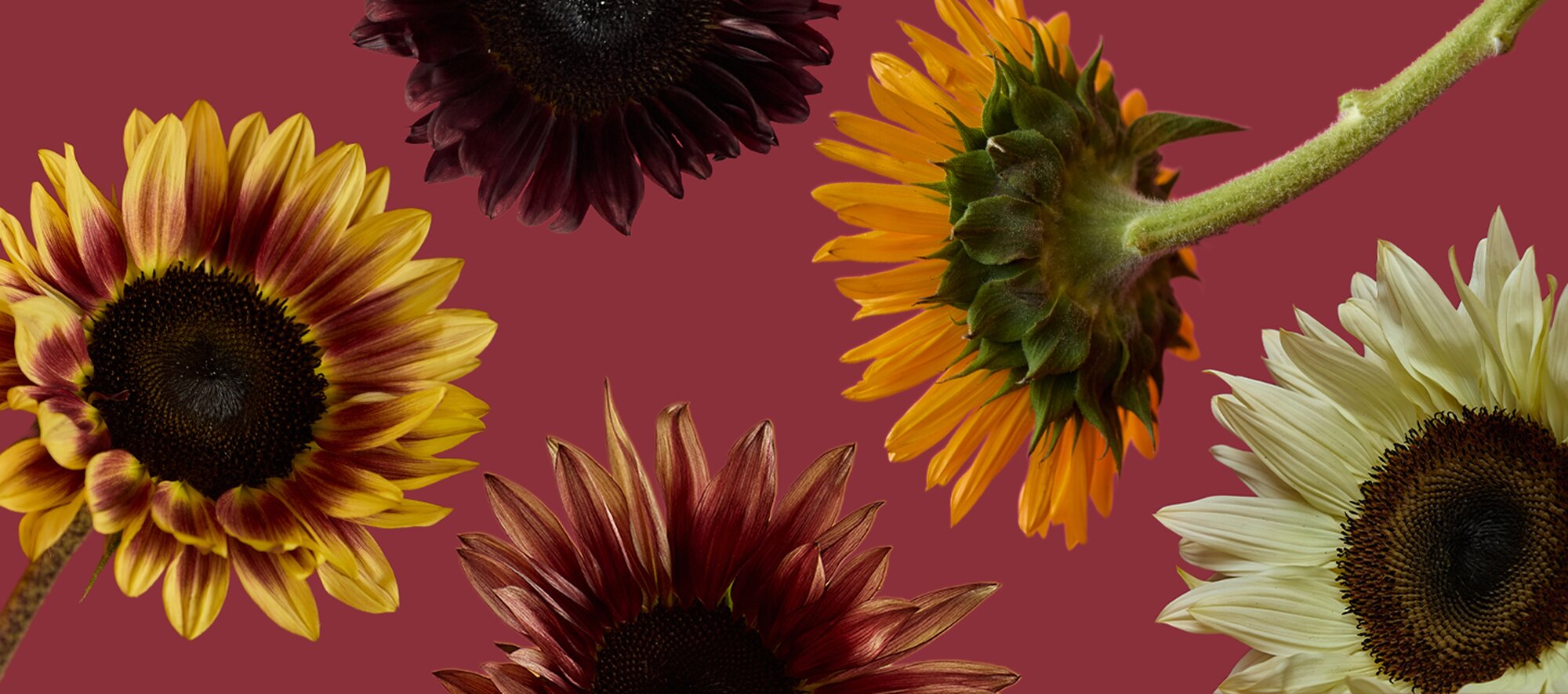

Sunflowers
Everything You Need to Know
Whether you see them dotted around fields, raising their heads from the garden, or arranged in a beautiful vase, sunflowers never cease to exude a joyful energy. While you may think of the sunflower as quite a common plant, it actually has a fascinating history, as well as a multitude of incredible uses. We’ve put our ultimate guide on sunflowers together for you, covering everything from care tips to symbolism.

The History of the Sunflower
Archeological evidence suggests that the story of sunflowers goes as far back as 3000BC, when Native Americans cultivated them in the area that’s Arizona and New Mexico today. Tribes used sunflowers mainly for culinary purposes - grinding seeds into flour or eating them as a snack, as well as for dye.
The plant was introduced to Europe in the 16th century, after Spanish explorers imported them from their travels to the Americas and found popularity as an ornamental plant, as well as for certain medicinal uses.
In 1716, English scientists were granted a patent for their method of extracting oil from sunflower seeds. Although the patent was received in England, it was actually Russia which raced ahead in large-scale oil production. The reason for that was quite simply that many foods that contained oil were prohibited by the Russian Orthodox Church during Lent. Sunflower oil, however, was not on that list and therefore immediately achieved popular status.
As its story continues, sunflower seeds travelled back and forth - being reintroduced in North America as both poultry feed and oil source and then being exported back over to Europe again to meet oil demands there.
Where does the name “sunflower” come from?
Sunflowers (Helianthus annuus) belong to the Asteraceae family, one of the largest flowering plant families that features over 1,900 different genera throughout the world. It includes a variety of plants from asters to artichokes and daisies to lettuce.
‘Sunflower’ is a direct translation of its botanical name, with ‘heli’ meaning sun and ‘anthos’ meaning flower in Greek. The name Helianthus was coined for the sunflower family by Swedish botanist Carl Linnaeus in his landmark work Species Plantarum (1753).

Debunking flower myths: do sunflowers follow the sun?
Sunflowers are often linked to the phenomenon of ‘heliotropism’ (or ‘phototropism’), the scientific name for plants that grow in a way that follows the path of the sun across the sky. The Italian common name for sunflower, ‘girasole,’ literally means ‘turning sun.’
The Royal Botanic Gardens at Kew, however, make it clear that while it is commonly believed that sunflowers are heliotropic, “only immature sunflower buds move from east to west, while the mature flowers permanently face east.”
Did you know? Contrary to their name, sunflower seeds are actually the fruit of the sunflower, also known as an ‘achene’.

Sunflower Symbolism: What do sunflowers represent?
The first image that comes to mind when one thinks of sunflowers is one of joy - late summer, golden hour, and large, bright yellow blooms raising their tall heads over a meadow or wheat field.
Even for troubled Van Gogh, The Sunflowers were painted during what the National Gallery calls “a rare period of excited optimism.” It is no surprise that these joyful flowers are linked to positivity and happiness, as well as adoration, friendship, and loyalty.
For the Incas, Aztecs, and the Otomi, sunflowers were also symbols to represent their various sun gods.
Did you know? The sunflower is the national flower of the Ukraine, which is also one of the largest producers of sunflower oil in the world.
The Ultimate Sunflower Care Guide
Step 1: Conditioning Sunflowers for the Vase
- Cut: Trim the ends of your sunflower stems at a sharp 45° angle with a clean cut. This is especially important as sunflowers release a slightly milky sap when cut, which can block water uptake. Re-cutting and placing them in clean water immediately helps prevent this.
- Defoliate: Remove any leaves from the stems that would sit below the vase neckline. This helps keep the vase water clean and prevent build-up of bacteria.
- Hydrate: Pop them in some room temperature water with flower food to re-hydrate.
Step 2: Arranging Sunflowers in a Vase
Sunflowers come in different varieties and sizes - while large, tall stems can set beautiful accents in a mixed arrangement, there’s also dwarf varieties that take up less space and suit smaller vessels perfectly.
Step 3: Making Sunflowers Last in a Vase
Re-cut the stems and refresh the vase water every 2-3 days to keep your flowers fresh.

Uses for sunflowers
Apart from brightening our days as a sight for sore eyes and ornamental flower, the sunflower and its seeds are an important food crop that’s also processed to create sunflower oil. The seeds can also be eaten raw or roasted for a nice little snack. Both the seeds and left-over husks from processing sunflower seeds into oil are also used as animal feed.
Apart from their culinary uses for both humans and animals, sunflowers can also be used to produce yellow and purple dyes, or even to produce biofuel when sunflower oil is mixed with diesel.
Did you know? Sunflowers can also remove toxic elements from soils, like lead and uranium. They have been used in clean-up operations at both Chernobyl and Fukushima.
What to do with your sunflowers…
You don’t have to have a full golden crop of sunflowers to reap the rewards of the seeds. Once you’ve got all your joy out of your sunflowers in the vase, hang them up to dry them out, in a few weeks time they will be completely dry and you can rub the sunflowers face and the seeds will drop out.
Collect them all up and store them safely until you’re ready to plant again.

How to Grow Sunflowers in the UK
Sunflowers are easy to grow in the UK and thrive in a sunny, sheltered spot with well-drained soil. For best results, they need at least 6–8 hours of direct sunlight each day.
You can start sowing sunflower seeds indoors from mid-April or plant them directly outdoors from May, once the risk of frost has passed. If starting indoors, transplant seedlings outside once they are around 20–30cm tall and strong enough to handle outdoor conditions.
Water your sunflowers regularly, especially during dry spells, and support taller varieties with stakes to prevent them from bending or snapping in the wind. With the right care, sunflowers will bloom from July through to early September in the UK.
FAQs
Are sunflowers toxic to cats and dogs?
Sunflowers are classed as non-toxic to cats and dogs by the ASPCA, so they’re a safe option for homes with pets.
Why do sunflowers droop in a vase?
Sunflowers have large heads and are thirsty flowers, which means they can become top-heavy and droop if they’re not properly hydrated or bacteria has built up in the vase. To fix this, recut the stems at a sharp angle and refresh the water. We also recommend keeping them out of direct sunlight.
When is the best time of year for sunflowers in the UK?
The best time to see sunflowers in the UK is between July and early September, with peak blooming times typically around August. If you’re keen to enjoy them in your garden, start seeds indoors between mid-April and May, or direct sow outside around May once risk of frost has passed.
How long do sunflowers last in a vase?
Sunflowers typically last between 5 to 7 days in a vase when properly cared for. To maximise their vase life, trim the stems every few days, change the water regularly, and keep them away from direct heat and sunlight.
Do sunflowers need a lot of water?
Yes, sunflowers are particularly thirsty flowers due to their large heads and thick stems. They require plenty of fresh water to stay hydrated, so it’s important to keep the vase topped up and change the water every 2–3 days.
Can I grow sunflowers in pots or containers?
Yes, sunflowers can be grown in large pots or containers, especially dwarf varieties. Make sure the container has good drainage and place it in a sunny location with regular watering.

Posted on 27th May 2024
Up next...
Inspiration
Spooky Stems
Just in time for Halloween season, we’ve put together a few of our favourite spooky stems.
Flowers
How to Arrange Front-Facing
We’re here to share some of our expert tips to make your flowers pop when you arrange them front-facing.